The Delta Issue #105
Enough with the Edujargon.
Hi all, Kunjan here.
I want you to imagine a giant game of telephone. A state education leader has a message they want to reach every classroom: Every teacher needs to be trained on the new curriculum before the school year starts.
They tell a superintendent, who tells a district leader, who tells a principal, who tells a teacher, who tells a parent. I’d bet some version of that message makes it to the other end.
Now imagine the message is: Build school-level instructional capacity through differentiated, job-embedded professional learning structures that enable the high-fidelity implementation of standards-aligned, high-quality instructional materials within a coherent instructional framework.
Good luck. I’d say there’s a pretty low chance that everyone who needs to act on that message will walk away knowing what they’re actually supposed to do: make sure every teacher and coach is trained on the new curriculum.
It’s one of our worst habits in education: we take perfectly clear actions and pile on so much jargon that you practically need a glossary to figure out what we’re asking people to do. Then we send those messages from state leader → superintendent → district leader → principal → teacher → parent and hope they survive every handoff. The more jargon, acronyms, and 25-word phrases we pile on, the more likely the message gets muddled or lost altogether.
We play this giant game of telephone every day, and the stakes aren’t trivial. We’re trying to get millions of kids reading and doing math. We’re trying to improve attendance. We’re trying to make sure teachers have great curricula and students who fall behind get the support they need. We need everyone rowing in the same direction, and that requires a clear, shared understanding of where we’re going and what each of us needs to do to get there.
Making something sound more academic or complex doesn’t make it more effective. When you need an idea to travel through an entire system and change what happens in classrooms, clarity matters more than complexity.
Simplicity isn’t dumbing down the work; it’s a skill and a superpower.
So, as we head into a new school year, I have a plea for all of us: Enough with the edu-jargon. If we want our biggest ideas to reach classrooms, let’s say what we mean—and say it clearly.
How to Say What You Mean
Here’s one trick I’ve found useful: look for the action buried underneath the jargon.
“Build capacity.” To do what?
“Leverage data.” How?
A lot of edu-jargon describes the machinery of the work instead of the thing we actually want to happen. If you have to stop and think about what a phrase actually means—or what you want someone to do differently after hearing it—that’s a pretty good sign it’s time to say it another way.
Let’s practice together. We pulled some real edu-jargon from across the sector and stripped it down to what we’re trying to say.
(These are representative examples, not phrases from any one organization.)
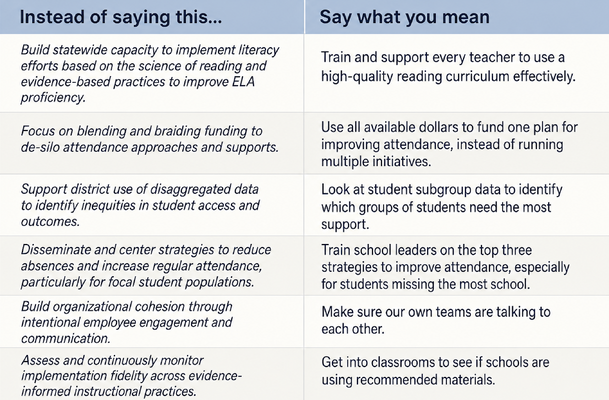
None of those translations capture every technical nuance, and that’s okay. Sometimes it matters more that the idea gets through, and that the people responsible for making it happen understand what you need them to do.
Your Turn: Try the Telephone Test
Think about the next strategic plan, initiative, presentation, or piece of guidance you’re working on. Before you send it out into the world, ask yourself two questions:
- What are the five or ten words I desperately need to make it to the other end?
- What do I need the person on the other end to actually do?
Write down your answers. Then ask: Could a teacher hear this message today and explain it to another teacher tomorrow? If not, simplify it.
We talk a lot around here about implementation, and this is part of it. We can build the most sophisticated framework, coin the perfect acronym, or produce the 100-page strategic plan. But changing what happens in classrooms requires thousands of people to understand what we’re trying to do, why it matters, and what they need to do differently tomorrow.
So, try the telephone test on your own work: strip away the jargon, find the action underneath it, and make sure the important part survives the trip.
Let’s Get Muddy
- What piece of edujargon would you nominate for translation? Drop it in the comments, and let’s see if we can say it more clearly.
- Want to take this one step further? Read our previous Delta on turning vague platitudes into specific behaviors—and getting clearer about what we actually need people to do.