The Delta Issue #115
What Jen Pahlka, Kaya Henderson, and Sonja Santelises Taught Us About Making Change Stick
Hi y’all, Jessica here.
Last week, the Watershed team came together for our most recent staff advance.
We’ve spent the past five years building Watershed together, and it was wonderful to get everyone in one place to reflect on how far we’ve come and think about what we want the next five years to look like.
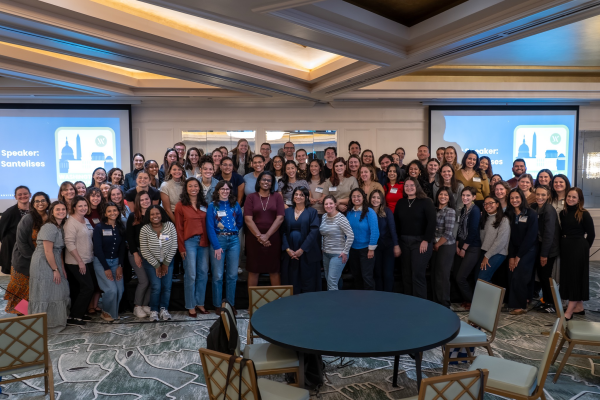
This advance was particularly special because we were joined by three leaders whose work we’re big fans of: Jennifer Pahlka , Kaya Henderson , and Sonja Santelises .
Between them, they’ve wrestled with government bureaucracy, made tough calls about what’s best for kids and communities, and learned a thing or two about bringing people along when change gets hard. Getting to pick their brains was a real treat, and their conversations sparked some great discussions among our team.
So, for this week’s Delta, I wanted to share a few of the ideas we’re still talking about.
1️⃣ Never forget who you’re working for.
Kaya Henderson , former chancellor of District of Columbia Public Schools (DCPS) and now executive director of The Aspen Institute ‘s Center for Rising Generations , told us to think about kids as our constituents. They’re the ones who have to live with the decisions we make, and they’re also the ones closest to the problems we’re trying to solve.
She shared a story from her time in DC, when the district was struggling with a big truancy problem and policymakers were struggling with what to do. Kaya invited some of the high school students who were missing the most school to sit down with her and explain why they weren’t showing up.
Turns out, some of them were running out of rides on their bus passes, and by the 10th of the month, they couldn’t afford to get to school anymore. What some saw as a problem with parents or kids misbehaving was, in fact, a problem of poverty.
Kaya took what she learned to the DC Council, which changed the transportation rules to provide students with free bus passes. Truancy dropped dramatically.
It’s a good lesson for all of us working in education: we can spend a lot of time coming up with solutions to problems we don’t always fully understand. Sometimes the smartest thing we can do is ask kids themselves.
2️⃣ Experiment where we don’t know. Implement where we do.
Sonja Santelises , former CEO of Baltimore City Public Schools , had a bone to pick with education’s obsession with the next shiny new thing. We spend so much time looking for what’s new that we sometimes forget to buckle down and get really good at what we already know works.
That doesn’t mean we should stop trying new things. As Sonja put it, where we don’t have the answers yet, we should experiment, test, and learn. Where we have good evidence, we should roll up our sleeves and focus on doing it well, day in and day out.
Sonja had a great way of describing what that looks like in practice: “toothpicking.” You know how you stick a toothpick into a cake to check whether it’s done? She argued we need to do the same thing in education.
When we roll out a new policy or initiative, we need to get into schools and classrooms to see how things are playing out, from how district leaders are supporting principals to what teachers are experiencing day to day. If something isn’t working, we need to figure out where things are getting stuck and make adjustments.
3️⃣Better outcomes start with tending the soil.
Jennifer Pahlka , author of Recoding America, joined us to talk about something near and dear to our hearts at Watershed: why government can make it so darn hard to get things done.
Jen had a great analogy for this. If you want something to grow, you can’t just keep planting new seeds. You have to make sure the soil is healthy enough to support them. You have to tend the soil.
We have a tendency to do the opposite in education. We spend an outrageous amount of time debating which new policies to adopt, but surprisingly little time asking whether the systems responsible for carrying them out are set up to succeed.
Do they have the right people? Can those people make decisions? When something isn’t working, can they change course?
You can have the best policy in the world, but if the people and systems responsible for implementing it aren’t set up to deliver, it’s not going to get very far.
The view from the ground matters.
Looking back on the week, I found it fascinating that Jen, Kaya, and Sonja, despite their very different experiences, were all making versions of the same point. Jen talked about tending the soil, Kaya talked about listening to the kids we’re trying to serve, and Sonja called it toothpicking.
You can’t improve a system from a distance. If you want to implement something well, you have to get close enough to understand what’s happening and involve the people who know the work best.
At Watershed, we talk about this as the implementation chain: the people and decisions at every level between a policy being adopted and a kid experiencing it in the classroom. I loved hearing three people who’ve spent their careers doing this work arrive at the same conclusion in their own ways.
Let’s Get Muddy
- Keep up with Jennifer Pahlka , Kaya Henderson , and Sonja Santelises on LinkedIn. We’re always learning something from them, and think you will, too!