The Delta Issue #104
More Districts Are Facing School Closures. Here’s What We Can Learn from New Orleans.
Hi everyone, Kunjan here.
The trajectory for students in New Orleans looks very different today than it did twenty years ago. Back in the early 2000s, just over half of students graduated. Today, more than four in five do. More than three times as many students are now reaching mastery on state assessments, putting New Orleans ahead of several of Louisiana’s largest districts.
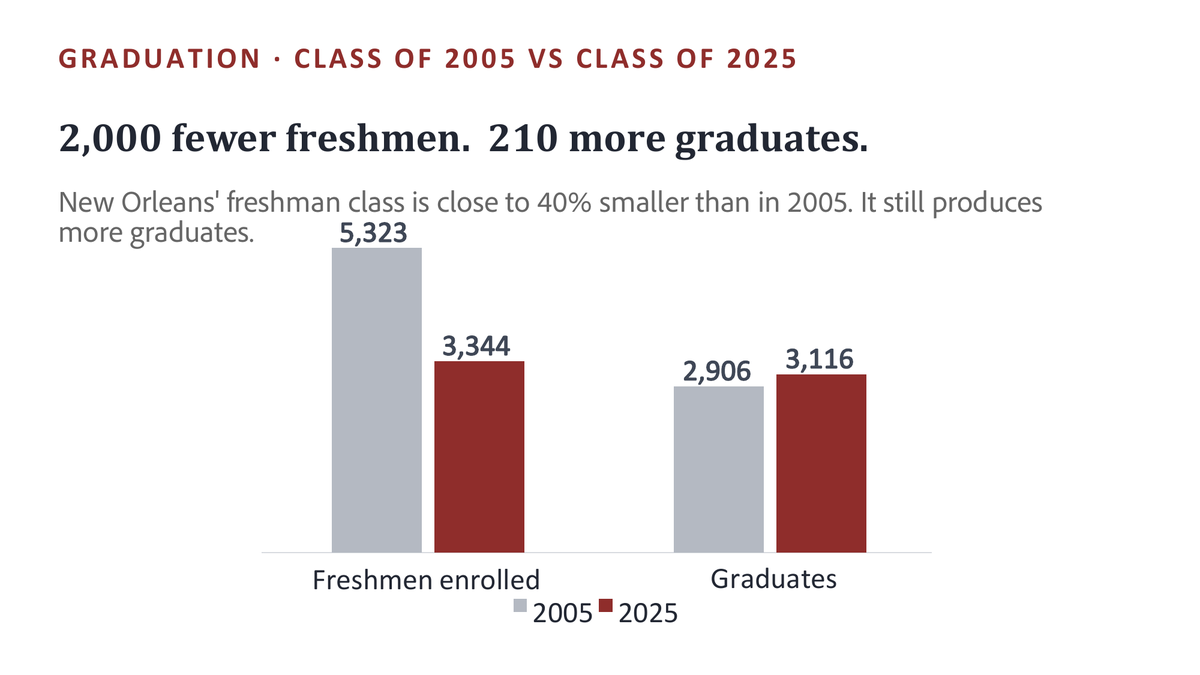
The New Orleans story is one that’s near and dear to both Jessica Baghian and me, and we’ve written and spoken about it many times before. (Check out our ‘Katrina, 20 Years Later’ piece.) This week, though, I want to focus on one part of that story that doesn’t get talked about nearly as much: school closures.
Let me start by saying that no one in New Orleans took these decisions lightly. Closing a neighborhood school is one of the hardest things an education leader can do. But we also believed that continuing to leave students in schools that weren’t delivering the education they deserved wasn’t an acceptable alternative. One of the ways New Orleans improved outcomes was by making the difficult decision to close persistently low-performing schools and create room for higher-performing local operators to grow.
Today, a growing number of state and district leaders are confronting the same difficult decision—whether to close schools—but for very different reasons. Since the pandemic, public school enrollment has declined by millions of students nationwide, inflation has driven up the cost of everything from transportation to utilities, and states are beginning to face tighter budgets as spending on programs like Medicaid and SNAP continues to grow. Those pressures aren’t going away. If anything, they’re likely to make conversations about school closures more common in the years ahead.
Here are 4 lessons we learned in New Orleans that may be useful as more communities begin navigating similar conversations.
1️⃣ Start with students, not buildings
Closing a school building causes massive disruption for communities. If leaders are asking families to make that sacrifice, they need to clearly answer: What will students gain in return?
In New Orleans, our goal was never to close schools for the sake of closing schools. Our goal always started with kids. That meant being crystal clear about our vision to expand access to stronger instruction, stronger academic programs, and greater opportunities than students had before. Sometimes that meant closing schools. And as lower-performing schools closed, higher-performing operators were able to grow, and students from closing schools received first priority for seats in those schools.
Whatever the circumstances, families deserve to know how these difficult decisions—and the resources they free up—will be used to improve their children’s educational experiences.
2️⃣ Bring communities into the process
One of the most important lessons we learned in New Orleans is that school closures can’t be something you do to a community; they have to be something you navigate with a community. There are two things leaders can do to make that possible.
- Start by sharing the data. At the very beginning, have conversations with families about why school closures are on the table—before any decisions are made. Walk through the financial reality, show the enrollment trends, and explain the student outcome data. If a school can no longer afford AP courses, extracurriculars, or the student supports kids deserve, say so. If keeping an under-enrolled building open means fewer dollars are going into classrooms, explain that too. Parents want what’s best for their kids. Be honest about the tradeoffs, and explain why you believe this decision will ultimately create better opportunities for their children.
- Invite families to the table. Ask for their feedback. Listen, because no one knows a community better than the people who live there. In New Orleans, we didn’t get this right at first. Early on, we moved too quickly and treated closures as decisions to announce rather than conversations to have. Over time, we realized what a mistake that was and got much better. We invited alumni groups, neighborhood leaders, and families into the process. When it came to deciding what would happen to a school building, we even created community advisory boards where residents could bring ideas to the table, weigh different options, and vote on the path forward.
One of my biggest takeaways from that experience was this: You don’t have to agree with every perspective or every idea, but you do have to recognize how profoundly these decisions affect people’s lives. For some families, it means driving twenty minutes to a school that used to be around the corner. For others, it means saying goodbye to the school their parents, grandparents, or even great-grandparents attended.
Closures are incredibly sensitive. While you can’t sugarcoat them, you can soften the landing. Make sure people understand why you’re making the decision, feel they had a voice in the process—in deciding whether and which schools are closed and what comes next—and leave knowing they were heard.
3️⃣ Have the courage to make the hard calls
Nobody wants to close a school. Nobody wants to stand in front of families, alumni, teachers, and students and tell them the place they’ve loved for decades is closing. Nobody wants to be remembered as the leader who closed the neighborhood school. These are heartbreaking decisions, and they stay with you.
But postponing a difficult decision doesn’t make it any less painful. It usually makes it worse.
Every year a district continues spending scarce dollars maintaining underutilized buildings, it’s working against the best interests of students. Students remain in schools that may no longer be able to provide the opportunities, programs, or experiences they deserve. Dollars that could be invested in instruction are instead spent keeping buildings open. And as financial pressures continue to mount, leaders often find themselves with far fewer options than they had just a few years earlier.
Leadership in education means accepting responsibility for decisions that are unpopular in the short term because they’re necessary in the long term. If every signal points to closure being the right path, have the courage to act, knowing it’s in the best interest of kids.
4️⃣ Expand opportunities for all kids to access great schools.
If you’re not cognizant about who a closure will most impact, there’s a good chance you’ll end up deepening the very inequities you’re trying to solve.
New Orleans serves a predominantly Black student population, including many students from low-income families and students with disabilities. We know that, historically, school closures have disproportionately affected low-income communities and communities of color. If we were going to ask these communities to bear the burden of school closures, we also had a responsibility to make sure they benefited from them.
Students attending a closing school, for example, received priority access to higher-performing schools. Because closures can create transportation barriers, we provided yellow bus service for all K–8 students. We also paid close attention to geography so excellent schools weren’t concentrated in just one part of the city.
There isn’t a copy-and-paste solution for every district or every community. Rural districts, for example, face very different transportation realities than an urban district like New Orleans.
Every decision, however, should be evaluated through an equity lens. Think intentionally about how this decision creates more opportunity for the students who have historically had the fewest choices.
Let’s Get Muddy
I’ve written and spoken about the New Orleans story quite a bit over the years. If you’d like to dig deeper, here are a few resources I’d recommend:
- For a much deeper dive into New Orleans’ progress over the past twenty years, check out Leslie Jacob’s fantastic presentation of the data.
- Want to dive deeper? Check out Bellwether ‘s latest report, The Hidden Geography of School Enrollment Decline: Exurban, on how enrollment shifts are changing the landscape for school districts.