The Delta Issue #86
The gender gap in education leadership is getting narrower, but it’s not gone
Subscribe to The Delta on Spotify or Apple Podcasts for more conversations like this.
Hi y'all, Jessica here.
Women make up more three-quarters of teachers, but only about one-third of large-district superintendents.
So why aren't there more women in the central office?
(Hint: it's not a problem with women)
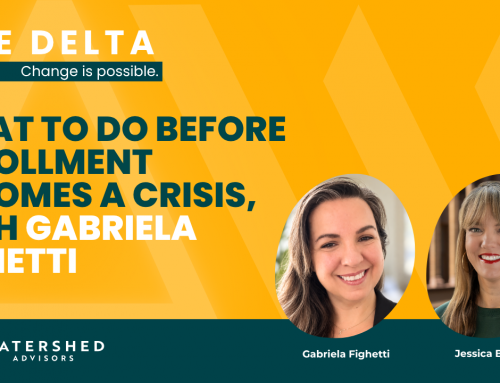
In this week's Delta, I'm joined by Dr. Julia Rafal-Baer , a longtime colleague and the founder of ILO Group and Women Leading Ed , which supports more than 600 leaders across all 50 states.
We get into what's driving the gender gap in education leadership, including how talent search processes disadvantage women and how bias shows up in ways that are often hiding in plain sight.
Julia's message to women leaders, both aspiring and current, is one we deeply believe at Watershed: even if the path is harder for women, you are ready. Go for that next role, trust yourself, and stay close to the people who want to see you rise.
Watch our full conversation below.
Women Shaping Education Today: Ju
The transcript below has been edited for brevity and clarity.
Jessica Baghian: Welcome to The Delta. I'm Jessica Baghian , President of Watershed Advisors . This month, for Women's History Month, we're highlighting women shaping education leadership.
Today, I'm joined by a dear friend and colleague, Dr. Julia Rafal-Baer , CEO of ILO Group and Women Leading Ed , the nation's largest network of women education leaders, supporting more than 600 leaders across all 50 states through sponsorship, professional development, and community.
Before this, Julia served as Assistant Commissioner at the New York State Education Department and as Chief Operating Officer at Chiefs for Change , where we first met many years ago. Julia, thank you so much for being here.
Julia Rafal-Baer: Thanks so much for having me—this is so much fun.
The State of Women in Education Leadership
Jessica: Let's start with the state of women in education leadership.
You've long made the point that while women dominate the teaching workforce, they're still underrepresented in leadership roles, especially in central offices. Your team has built a robust dataset tracking superintendent leadership over time.
Where have we made progress, and where are we still seeing challenges?
Julia: Let's go back to the beginning—2018, when we were sitting in that conference room together.
We now have 10 years of data, and it shows clear progress. In 2018, only 27% of the top 500 superintendents were women. Today, we're at 33.4%. That's measurable progress, but we're far from done.
Back then, every woman in that room said the same thing: they had no network, no support system. What we were trying to build didn't exist.
Now, in 2026, Women Leading Ed is an independent nonprofit, the largest national network of its kind. We've surpassed 600 members, with representation in every state. Our summit this year will bring together 250 women.
We've moved from asking what's happening to women in leadership to having real data, and now we can ask better questions about their experiences.
How Search Processes Shape Who Gets the Role
Jessica: One of the things you study closely is how superintendent searches shape outcomes, especially the role of search firms and boards. What have you learned?
Julia: A lot, and not all of it is encouraging.
Most searches rely on networks of retired superintendents who tap people they know. That tends to reproduce the same candidate pools, often white men tapping other white men.
So from the start, the pool is limited.
Then there's bias in the process itself: different questions for men and women, different expectations, and assumptions about what leadership "looks like."
There's also a structural issue. Many search firms now offer services beyond the search—100-day plans, coaching, strategic planning. Boards often sign those contracts upfront, which creates incentives that compromise neutrality.
At minimum, states should require search firms to do one thing: run the search. Nothing else.
How Hiring Practices Disadvantage Women Candidates
Jessica: Within that system, how are women positioned differently?
Julia: Our data shows clear patterns.
Men are far more likely to be hired as external candidates, chosen based on perceived leadership traits like decisiveness or toughness.
Women are more likely to be promoted internally, often after serving as interim superintendent. In fact, about half of women who serve as interim are then selected permanently. They have to prove they can do the job first.
We also see bias play out in real time.
In one state, a male candidate admitted during an interview that he didn't understand how the system worked, and that was framed as humility. He was selected over highly qualified women.
In another case, a candidate was praised for speaking without notes. What was clearly unpreparedness was framed as charisma.
And then there's the story of Marie Izquierdo in Sarasota. She was the top candidate at every stage, until the board asked about her family. She said they wouldn't move mid-year, and that became the deciding factor.
I had placed dozens of leaders at that point. Not one man had been asked—or judged—on whether his family would move.
The bias isn't hidden. It's happening in plain sight.
Leadership Pipelines and What We Value
Jessica: Have you studied what actually makes leaders effective, and how that should shape hiring?
Julia: We're working on a major research proposal to answer exactly that.
But we already see pipeline issues. Men are more likely to become high school principals—roles with bigger budgets, visibility, and operational experience. That leads to central office roles like COO.
Women are more likely to become elementary principals and then move into academic roles.
So when leadership roles open, the pipeline favors operational experience, even when the moment calls for academic leadership.
At the state level, governors often prioritize candidates with operational backgrounds. But if the goal is academic recovery, we should be asking: who wakes up every day thinking about student learning?
Two Ingredients for Leadership Success
Jessica: Once leaders get the role, these are incredibly demanding jobs. What helps them stay and succeed?
Julia: Two things.
- First: networks. Women Leading Ed provides real-time, 24/7 support. That sense of community—knowing someone has your back—is everything.
- Second: sponsorship, not mentorship. Mentors share advice. Sponsors invest in you. They push you, give you stretch opportunities, and hold you to a high bar.
We also need to rethink how we view feedback. Feedback is investment. It's someone saying: I believe you can meet this bar.
Advice for Women Leaders
Jessica: What advice would you give to women who want to step into leadership?
Julia:
- First, you're ready. Our data shows women wait longer at every career stage than men. They stay to finish projects, meet obligations—but men don't wait the same way.
- Second, these jobs are complex—and we need to acknowledge realities like elder care that many women leaders are increasingly navigating. We've made some progress on childcare, but not here. Leaders should be negotiating for that support.
- And third: the power of duos. Leadership is stronger when you rise with someone you trust, someone who challenges you and has your back.
Jessica: To close, who is one woman in education we should be paying attention to?
Julia: Crystal Hill, Ed.D. in Charlotte-Mecklenburg.
She stepped in as an internal candidate, after a period of constant leadership turnover. She's stabilized the district, led major academic change, and is approaching AI implementation thoughtfully and ethically.
If we had more leaders like her, we'd see real transformation.
Jessica: I love that. Julia, thank you so much for joining.
For those watching, you can find this conversation and others in our Women's History Month series by searching The Delta on your favorite podcast platforms—or on LinkedIn.
Thank you so much.
Let's get muddy
- Check out WLE's new 2026 Insight Survey, capturing perspectives from over 200 women education leaders and challenging the narrative that there's an "ambition gap" in the workplace.