The Delta Issue #82
Inside Federal Education Policy with Lindsay Fryer
Subscribe to The Delta on Spotify or Apple Podcasts for more conversations like this.
Hi y’all, Jessica here.
Women make up the vast majority of the education workforce, but they are still underrepresented in many of the roles where the biggest decisions get made.
Women’s History Month is a moment to pause and recognize the many women, past and present, whose leadership has changed the trajectory of education for kids, often through persistence, courage, and a willingness to take on the hard work of improving systems.
To mark the occasion, we’re sharing a series of short video interviews spotlighting leaders doing important work across federal policy, to state leadership, and education advocacy.
We’re kicking things off this week with Lindsay Fryer , who brings a rare mix of deep policy knowledge and practical perspective.
In this conversation, Lindsay cuts through the noise around federal education funding. She explains where policy is shifting, what leaders should be paying attention to, and how states might think about their role in the months ahead.
Watch the full video below.
The transcript below has been edited for brevity and clarity.
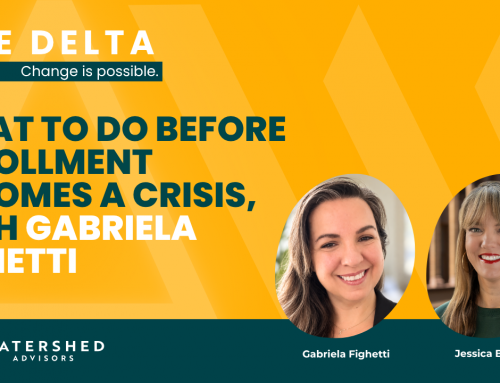
Jessica Baghian: Hello everyone and welcome to The Delta. I’m Jessica Baghian, President at Watershed Advisors .
Today I’m thrilled to be joined by Lindsay Fryer , President and Founding Principal of Lodestone DC . She previously served as a senior education policy advisor to Senator Lamar Alexander on the Senate HELP Committee and was a principal negotiator of the Every Student Succeeds Act (ESSA). Lindsay, thank you so much for joining us.
Lindsay Fryer: Thanks for having me. It’s always great to talk with you.
The Federal Policy Shift Toward Workforce Outcomes
Jessica: You’ve seen federal education policy from inside Capitol Hill and now work with organizations across the country. What’s one development in federal education policy that education leaders should be paying attention to right now?
Lindsay: One major shift is the growing alignment between education policy and workforce outcomes.
Across federal policy, there’s increasing emphasis on how education connects directly to employment and economic mobility.
- For the first time in history, federal Pell Grants will fund short-term workforce training programs, rather than only traditional college programs. That’s a huge change.
- Higher education programs will be evaluated using an earnings test. Programs will only qualify for federal financial aid if their graduates earn more than the typical high school graduate. So the federal government is increasingly judging program value through workforce outcomes.
- Career pathways, work-based learning, apprenticeships, and employer partnerships are becoming major priorities for federal education grants.
For education leaders—including in K–12—that raises important questions:
- Are programs aligned with regional labor market demand?
- Are schools partnering with employers and workforce systems?
- Can programs demonstrate employment and earnings outcomes?
The systems that thrive in this next phase of federal policy will likely be those that can answer a simple question: what opportunities does this program lead to for students?
That’s why we’re seeing the conversation about reinventing high school move beyond graduation rates and test scores toward economic mobility and workforce readiness.
Jessica: “Pathways” have been a buzzword for a while, but many systems struggle to make them real. States may identify priority pathways and build plans around them, but maintaining that work over time is difficult as labor markets change.
Are there places doing this well? And is there anything happening at the federal level to help states stay nimble?
Lindsay: One foundational piece is data infrastructure. If states don’t have strong education-to-workforce data systems, they can’t see how students fare after high school or how programs align with labor market demand.
Many states are trying. Louisiana has done important work here, and states like Ohio, Indiana, and Texas are investing heavily as well. But this is difficult work because it requires blending multiple funding streams and coordinating across agencies.
One thing that may help is AI. AI could give systems faster access to labor market insights rather than waiting years for traditional data sources.
I also think it’s important not to focus only on industry-specific pathways. Building durable skills that prepare students for a range of industries can help systems respond to changing labor markets.
Should education leaders worry about federal funding?
Jessica: There’s been a lot of anxiety in education policy conversations over the past year. What’s one thing people are worried about that you’re less concerned about?
Lindsay: One of the biggest fears I hear is that schools won’t receive their federal education funding.
Last year did create uncertainty; there were grant cancellations, concerns about impoundment, and a proposed federal budget with significant cuts.
But the reality is that many contracts were restored, and schools ultimately received the funding they were owed. We now also have a finalized federal funding agreement that continues education funding and even increases some key programs like Title I, IDEA, and charter schools.
So from my perspective, we may be entering a more stable federal funding environment.
Another important development is that the Department of Education has finalized its discretionary grant priorities, including literacy, AI in education, civics education, school choice, career pathways, and meaningful learning opportunities.
The department now has its own priorities and wants to fund work aligned with them, which creates more predictability moving forward.
The Changing Role of the Federal Government
Jessica: Last year felt chaotic for many people working in education policy. Why do you think those dynamics played out that way?
Lindsay: Part of it reflects an effort to test the limits of federal authority.
The administration had made commitments to reduce federal spending and began exploring where cuts could occur, testing how far they could go legally.
But the checks and balances system matters. Courts pushed back in several cases, and advocacy from both Republicans and Democrats—especially around formula funding—was strong.
That made it clear that withholding education funding was not acceptable.
The lesson is that advocacy still matters, and when many things are threatened at once, it becomes clear what the field views as non-negotiable.
Jessica: How should education leaders think about the role of the federal government right now?
Lindsay: Given the current dynamics in Washington, I would advise state leaders to think of the federal government less as a driver of policy and more as a partner providing resources and guardrails.
In earlier eras—during No Child Left Behind or Race to the Top—the federal government played a much stronger role in directing large-scale reforms. I don’t expect that level of leadership from Washington in the near future.
Congress is unlikely to revisit major K–12 legislation soon, and the administration is focused elsewhere.
That means states should take the lead on major reforms—whether redesigning high school, aligning education and workforce needs, or building modern data systems.
Federal funding will still be there to support the work, but states will increasingly shape where policy goes next. Personally, I think that balance—federal guardrails combined with state innovation—is the appropriate federal role.
Advice for Women in Education Policy Leadership
Jessica: Since we’re celebrating Women’s History Month, what advice would you give women who want to step into education policy leadership?
Lindsay: Three things.
- Develop real policy expertise. Leaders who understand how legislation, funding, and implementation work become incredibly valuable.
- Build relationships across differences. Education policy only moves when people with different perspectives are willing to work together.
- Don’t wait until you feel perfectly ready. Raise your hand for difficult problems and leadership opportunities. You don’t have to check every box before you belong at the table.
If you care deeply about improving education and are willing to do the work, you deserve to be in those rooms.
Jessica: Before we wrap up, who is one woman in education whose work people should be following right now?
Lindsay: It’s hard to choose just one. There are so many strong women leading in education right now.
At the state level, leaders like Katie Jenner in Indiana, Amy Guidera in Virginia, Carey Wright in Maryland, and Christina Grant at Harvard are all doing important work.
One leader top of mind for me is Margaret Spellings and her team at the Bipartisan Policy Center . She has consistently pushed the field to focus on results and accountability for students.
The Bipartisan Policy Center is about to release a national talent strategy report from the Commission on the American Workforce, which I helped work on. I think it will add an important voice to the conversation about linking education to economic mobility.
Jessica: Lindsay, thank you so much for joining us and for sharing your perspective.
For those watching, you can find this conversation and others in our Women’s History Month series by searching The Delta on your favorite podcast platforms. You can also watch the full video and read the transcript on LinkedIn.
Thanks again, Lindsay.
Lindsay: Thanks so much. Great to be with you.
Let’s get Muddy
- The Bipartisan Policy Center has released a new report laying out a national strategy to better align education and workforce outcomes.