The Delta Issue #74
District Consolidation and the Cost of Fragmentation
Hi everyone, Kunjan here.
Did you know that New Jersey has over 600 school districts, 16 of which are non-operating? Or that, in Oregon, there’s a county where 7 different school districts each operate a single school with fewer than 15 students?
The U.S. education system is plagued by a problem very few people have been paying attention to: too many school districts.
It’s beginning to change. Over the past year, district consolidation—the idea of merging some school districts together—has re-entered the conversation as states grapple with declining enrollment, tightening budgets, and in some cases, legal challenges tied to segregation and equity.
Consolidation is a touchy subject for many communities, and for understandable reasons. School district boundaries shape where families live, where kids go to school, and how communities define themselves. When consolidation comes up, it can feel like the rug is being pulled out from under people.
But the reality is, many states have too many school districts, and that fragmentation is both inefficient and detrimental to student outcomes.
States need to lead through consolidation
Consolidation can’t be left to districts to sort out on their own. It’s not something most districts will volunteer for—the political risk is high, the process is complex, and district leaders and school boards would be asked to approve changes that reduce or eliminate their own roles in the name of efficiency. Individual communities aren’t positioned to solve this on their own. This is a collective governance problem—and if consolidation is going to happen, it has to be led at the state level, through legislative and executive action.
Fragmentation is inefficient
If you want a clear example of inefficient government, look at how education is administered across hundreds of separate school districts.
Running a school district comes with a set of fixed costs that are the same no matter how big or small the district. Every district, regardless of size, requires administrative infrastructure—CFOs, HR teams, procurement systems, legal review, technology contracts, and compliance processes.
Multiply those overhead costs across thousands of districts, and you have a system where untold dollars go to sustaining administrative systems rather than serving students in classrooms.
Consolidation is one of the few levers states have to address this problem. By reducing duplication and creating larger administrative units, states can redirect resources away from overhead and toward classrooms.
Fragmentation slows implementation
For state leaders, having too many school districts makes it far harder to execute on a coherent vision.
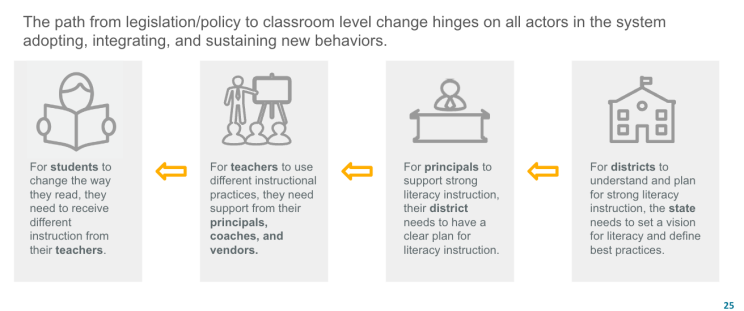
Every policy that passes has to move through what we call the implementation chain, the sequence of individuals whose actions influence how a policy gets from the statehouse to classrooms. The more districts a state has, the longer the chain becomes.
In our examination of why the South has been outpacing the nation on academic achievement last year, we noted that many Southern states organize school districts at the county level, resulting in fewer, larger districts with a greater internal capacity to support students. States with extreme fragmentation end up spending more to manage complexity, and less on direct delivery.
What should be a coordinated statewide effort turns into hundreds of parallel processes, each operating on its own timeline and interpreting guidance differently. It’s hard enough to move policy when you’re working with 20 superintendents. Try doing it with 200—or 2,000.
The result is a governance structure where accountability is diffuse by design. Responsibility is spread across so many actors that outcomes lack clear ownership, making it easy to deflect blame and difficult to drive improvement.
Consolidation isn’t a cure-all for implementation challenges, but in states with highly fragmented district systems it can be an important step toward maintaining a clearer, more consistent implementation chain.
Fragmentation reinforces segregation
School district boundaries shape opportunity and, too often, reinforce economic and racial segregation.
American communities tend to be segregated by race and class. When a metro area is carved into dozens or even hundreds of small school districts, that separation gets baked into the system. Research shows that school district boundaries reinforce segregation by tying educational opportunity to where families live. In many metro areas, separation by district boundaries accounts for more than half of white–Black segregation.
But research suggests that district mergers can both racially integrate schools and increase funding fairness by allowing for more coordinated planning across communities. In New Jersey, a state which has one of the most segregated public school systems in the country, lawmakers are exploring consolidation as a way to end school segregation. And in Mississippi, a small, under-resourced county district—nearly all Black and struggling to meet basic standards—was merged into the neighboring Starkville district, which had greater capacity and access to advanced coursework and other crucial resources. The consolidation was disruptive and initially controversial, but it gave many more kids access to good schools, and—according to The Hechinger Report —skeptics’ worst fears never materialized. The Superintendent reported that families are even coming back to the district from private school since the merger.
With fewer, larger districts, states can design magnet school strategies, create enrollment and transportation plans that cross neighborhood boundaries, and invest in programs that small districts could never sustain on their own.
Right now, many states can’t address segregation effectively because their governance structures make coordinated action nearly impossible.
How states should approach consolidation
If consolidation is coming—and in many places, it is—how it’s done matters.
States need a clear vision for why they’re merging districts, and they need to communicate that vision openly. For many families, choices about where to live are closely tied to school district boundaries. Changes to those lines can feel destabilizing and deeply personal. States need to acknowledge that reality, listen carefully, and ensure that feedback from families, educators, and communities shapes the final plan.
States should also be explicit and transparent about the problem they’re trying to solve. Consolidation is disruptive, but slow, unmanaged decline in school quality is worse. Leaders should show not just what would change, but what could be possible if more dollars flowed to classrooms and student supports. Done well, consolidation can streamline governance, make dollars flow more efficiently, and improve instructional quality. In some cases, it can also help communities integrate school systems that are currently segregated.
Ultimately, having too many districts isn’t an inevitable outcome of local control; it’s bad government. And bad government is something states and students can no longer afford.
Let’s get muddy
Have you seen other examples of district mergers gone right or wrong? What can we learn from those?