The Delta Issue #70
Child Care Funding Is Changing Fast. Here’s What States Need to Know.
Yesterday, we hosted a webinar with three of the smartest people in early childhood — Nasha Patel , Catherine Pozniak , and Rebecca Ullrich — to talk honestly about where the Child Care and Development Fund (CCDF) stands in this post-pandemic moment, and what states can do to keep their markets stable as federal funding pulls back.
Child care funding headlines for 2026 have been a depressing combination of delays, cuts, and crisis.
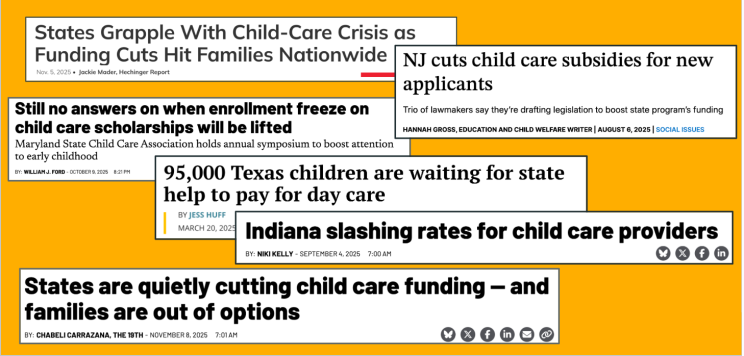
Across the country, child care leaders are performing fiscal gymnastics, serving more families than ever while still absorbing the loss of pandemic-era federal funding.
States have tools to navigate this moment and keep kids and families connected to care, but how they use those tools matters.
If you weren’t able to join us, the full recording is below.
To download the presentation slides, click here.
The four biggest takeaways for states:
- Start with your current state and how you got there.
Most states are facing a “perfect storm” of increased demand for subsidies, higher CCDF enrollment, higher-cost policies, and a steep fiscal cliff.
Before making any decisions, states need a clear-eyed view of:
- Their steady state (the amount of money a state can sustainably spend on subsidies a month), and how that differs from their actual monthly rate of spending on child care subsidies
- The historical policy choices that shaped today’s market
- Where providers are gaining or losing stability and how family demand has shifted
Understanding each of these pieces is essential to determining the next right move.
- Have a policy or programmatic outcome in mind.
Every lever—including rates, copayments, eligibility, waitlists—can be used differently depending on the outcome a state is trying to achieve. (Need a reminder on what we mean by levers? Check out this post.)
The first question is always: What are you trying to solve for? As you look at your state’s data, do you need to make adjustments to match your priorities? Does it suggest maintaining broad access? Slowing down spending? Stabilizing providers? Prioritizing the highest-need families? Boosting workforce participation?
CCDF levers are not inherently good or bad; they only make sense in the context of your goals, your market, and your budget. Without clarity on your goal, any lever can become blunt or even counterproductive.
- Recognize that the levers are interdependent and impact a broader market context.
Every policy lever interacts with the others. Raising rates increases the value of subsidy for families and providers, capping copayments can reduce available funding to serve kids in need, and expanding eligibility changes who is served and how far funding must stretch. Even a waitlist, which seems like a straightforward management tool, can reshape the provider market over time. Levers need to be used wisely, specifically, and in combination to accomplish your outcomes.
- Build a culture of data-driven decision-making.
This fiscal cliff moment heightens the need for reviewing data, but this exercise must be ongoing and responsive to your state’s market. If there is one piece of wisdom that applies to all states everywhere, it’s that the numbers should drive the decisions, not the other way around.
As Rebecca Ullrich shared, Virginia’s progress only happened because leaders were looking at real-time data and staying anchored to a single North Star: school readiness for all children.
For states, building this culture means using the right tools and tracking monthly spending against the steady state, shifts in family demand, provider capacity, waitlist trends, and whether policy changes are having the effect you expected, or not. You can read more here about how Virginia used copayments to provide more childcare seats.
Let’s get muddy
States are being asked to make hard choices with imperfect data and even less-than-perfect funding. These principles won’t make the tradeoffs disappear, but they will help states make decisions that protect access, stabilize providers, and strengthen their markets long term.
Watershed is here to help. If your team is wrestling with CCDF constraints, steady state modeling, or next-step policy decisions, reach out—we’re happy to continue the conversation.